Moto Camping: Everything You Need to Start
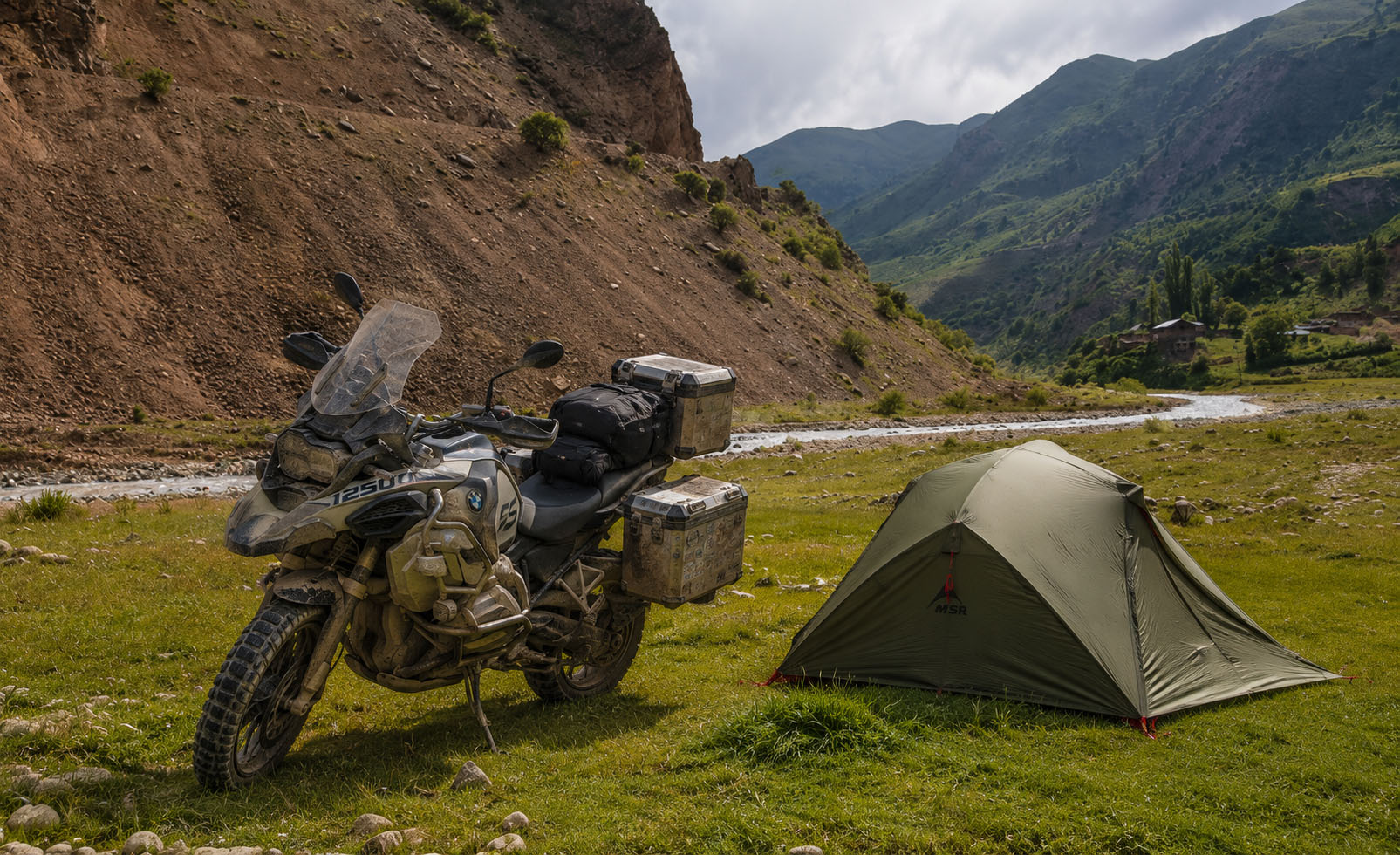
Moto camping is the purest form of motorcycle travel. You carry what you need, stop where you want, and wake up somewhere that isn't a hotel corridor. The barrier to entry is lower than most people think — you don't need a dedicated adventure bike, a full set of panniers, or an expedition-level budget.
Here's everything you need to know to start.
Why Moto Camping Is Different
When you camp from a motorcycle, the constraints of what you can carry force a clarity of purpose that car camping doesn't. You bring what fits. What fits is what matters. Everything else stays home.
That constraint is liberating. Your daily decision set narrows. You ride, you eat, you set up camp, you sleep, you ride again. The simplicity of it is the point.
The other thing nobody tells you: you stop more. On a hotel trip you're destination-focused — you need to reach the next town before check-in closes. On a camping trip, you stop when the light is good, or when a road looks interesting, or when you're hungry. The pace changes, and the riding becomes more itself.
The Minimal Kit
You can moto camp with a surprisingly small investment. Here's the minimum:
Tent: A single-person ultralight tent (1.2–1.8kg) that packs down small. The MSR Hubba Hubba and Big Agnes Copper Spur are benchmarks. A bivy sack is lighter still but claustrophobic for more than a night or two.
Sleeping bag: Rated to the temperatures you'll encounter, compressible, and ideally water-resistant. Down is lighter and compresses better than synthetic but loses insulation when wet. For warm-climate riding, a lightweight quilt works instead of a bag.
Sleeping mat: An inflatable sleeping mat. The Therm-a-Rest NeoAir series is the standard — excellent insulation, compresses small, relatively puncture-resistant.
Cooking: A small titanium pot, a gas stove (MSR PocketRocket or similar), a lighter, and a spork. Fuel canisters are available in camping shops and outdoors retailers globally. If you're crossing borders regularly, alcohol stoves (use locally-sourced fuel) cause fewer customs headaches.
Clothing: Three days of riding clothes, one set of off-bike clothes, one warm layer for evenings at altitude. Roll everything, rubber-band it, compress into dry bags. Vacuum compression bags are useless on a motorcycle — you can't compress them without a vacuum.
That full kit weighs around 5–7kg packed. Combined with food and water for a day, you're adding 8–10kg to the bike — manageable on almost any motorcycle.
How to Pack a Motorcycle
The loading principle: heavy near the centre and low. Weight high on a motorcycle raises the centre of gravity and changes handling. Weight behind the rear axle lightens the front wheel and makes steering feel vague.
Soft luggage vs. hard cases: Soft luggage (drybags, roll-top bags, tail bags) is lighter, cheaper, and absorbs impacts without cracking. Hard cases (aluminium panniers, moulded plastic) offer better protection for fragile items and resist theft. For camping, soft luggage is usually sufficient and more versatile.
A practical setup for most bikes:
- Tail bag or dry bag rolled and strapped to the pillion seat: main camping gear (tent, sleeping bag, mat)
- Tank bag (if your bike accepts one): map, snacks, phone, items you need quickly
- Small backpack (8–15L) on your back: valuables, tools, waterproofs
Don't overload the back of the bike. The tail bag should be kept light. If you're carrying more than you can lift comfortably with two fingers, it's too heavy.
Choosing Campsites
Paid campgrounds offer facilities — showers, toilets, sometimes power for charging devices. In Western Europe and North America, you'll use these most of the time.
Wild camping (free camping on unmanaged land) is legal in some countries (Scotland, most of Scandinavia, parts of Southeast Asia) and technically illegal but widely practised and rarely enforced in others. Know the rules in the country you're in.
The best free campsites are found via apps like iOverlander and park4night — both have large community databases of spots vetted by other motorcyclists and overlanders. Google Maps satellite view is useful for scouting spots away from roads.
For first-time campers, start with paid campgrounds — the facilities reduce the friction of learning the system. Once you're comfortable with the kit and routine, experiment with wild spots.
Food and Water
Water: Carry 2L minimum. A water filter (Sawyer Squeeze or similar, weighs 60g) allows you to refill from natural sources when available. In developed countries, restaurant fill-ups are usually possible. In remote areas, plan ahead.
Food: Supermarkets are a moto camper's best friend. Fresh food for the day, plus dried staples (instant noodles, oats, pasta, peanut butter) for when shops are closed. Freeze-dried expedition meals are expensive and unnecessary unless you're somewhere truly remote.
Cooking at camp after a long day's ride is one of the quiet pleasures of moto camping. Even simple meals taste better outdoors after a day of roads.
The First Trip
Keep the first trip short — two nights, a familiar area, a planned campsite. The goal isn't an epic journey; it's learning the system. You'll discover what you packed that you didn't use (leave it home next time) and what you wished you'd brought (add it to the kit).
Most first-timers overpack. The second trip is always better because you've eliminated the unnecessary.
The third trip is when you understand why people keep doing this.
For where to go, start with our guide to the best motorcycle roads in Southeast Asia. Ready to think about the bike for the job? Read our breakdown of the evolution of the modern adventure motorcycle.