Inside the World of Long-Distance Moto-Touring and Adventure Travel
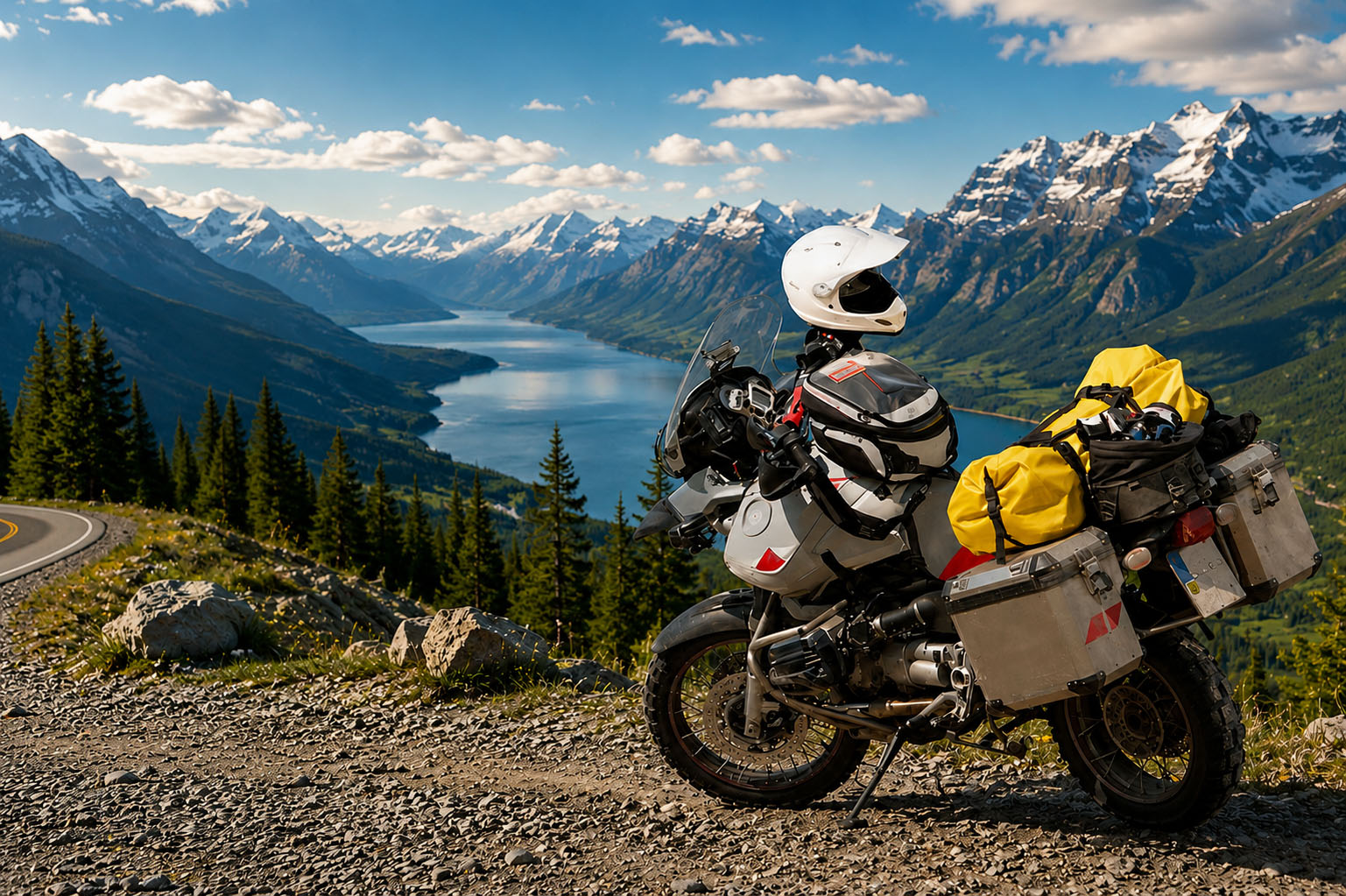
In 1973, a British adventurer named Ted Simon set off from London on a Triumph Tiger 100. Four years and 78 countries later, he returned having covered 78,000 miles — a journey that became the book Jupiter's Travels and inspired a generation of riders to ask: what if I just kept going?
That question has not lost its power. If anything, the adventure riding movement is larger, more connected, and more technically equipped than at any point in its history. But the essential impulse remains unchanged: put the bike on an uncertain road, point it at a distant horizon, and discover what you're made of.
What Draws People to Long-Distance Touring
Adventure riding attracts a specific type of person — not defined by age, income, or background, but by a particular relationship with uncertainty. The riders who do multi-month tours are not fleeing their lives. They are, almost universally, engaging with life at a higher intensity than they can access at home.
What the road offers that ordinary life doesn't:
- Radical presence — at 80 km/h on an unfamiliar road, your mind is entirely occupied with the immediate. There is no mental bandwidth for past regrets or future anxieties.
- Compressed relationships — strangers met at a campsite or a border crossing become close in hours rather than years, because the shared vulnerability of the road accelerates trust
- Genuine problem-solving — a puncture 200 km from the nearest town is a real problem requiring real resourcefulness, and solving it creates a satisfaction that no office task replicates
- The end of consumer identity — on the road, you are defined by what you do and how you treat people, not by what you own or where you work
The Minimalist Philosophy of Packing
The greatest mistake first-time touring riders make is overpacking. The temptation to prepare for every scenario results in a bike so heavily loaded it handles poorly, and luggage so dense that finding anything requires unpacking everything.
Experienced long-distance tourers converge on the same principle: pack for two weeks, not for the whole trip. Laundry exists everywhere. Resupply exists everywhere. What you cannot replace on the road is riding confidence — and that requires a bike that moves like a bike, not a furniture truck.
The Weight Framework
Most experienced tourers target under 25 kg total luggage weight for a month or longer trip in temperate climates.
What actually goes in the bags:
- 3 riding base layers (merino wool dries fast, doesn't smell)
- 1 mid-layer fleece
- 1 lightweight packable down jacket
- 2 pairs of riding socks + 1 camp sock
- Minimal toiletries — local shops exist everywhere
- First aid kit (compact, bias toward what you actually know how to use)
- Tool kit (specific to your bike — not generic, not excessive)
- Tyre repair kit and CO₂ inflators
- Documentation (passport, carnet, insurance, vaccination record in a waterproof folder)
- Navigation (downloaded offline maps are essential)
- Power bank + charging cables
What experienced tourers leave at home:
- Laptop (phone is sufficient for communication and navigation)
- Multiple pairs of shoes
- "Emergency" items they've never needed in 10 previous trips
Navigating Terrain and Micro-Climates
Adventure riding's defining characteristic is encountering conditions you did not plan for. Weather systems, road surfaces, altitude, and terrain vary dramatically within the same day's riding in mountain regions.
Reading the Road
Tarmac quality deteriorates in a predictable pattern: border regions, high-altitude areas, and areas with extremes of heat or cold all produce challenging surfaces. Loose gravel shoulders, potholed tarmac, sandy crossings, and mud all require different technique — and all require the ability to read the surface 50 metres ahead, not just the immediate foreground.
River crossings (common in Africa, Central Asia, and South America) demand a pre-crossing walk, an assessment of depth and current, and a commitment to a clean exit line. Hesitation in the middle is invariably the worst outcome.
Managing Altitude
Above 3,500 metres, altitude affects both rider and engine. Carburetor-equipped bikes run rich at altitude (less oxygen = less complete combustion). Fuel-injected modern bikes compensate automatically but can still experience reduced power.
Riders experience fatigue more rapidly, headaches, and sometimes altitude sickness above 4,000 metres. Acclimatisation — spending a night at intermediate altitude before ascending further — eliminates most symptoms.
The Rise of ADV Communities and Digital Route Mapping
Long-distance touring has always had a community, but the internet transformed it from a small network of dedicated obsessives into a global, interconnected movement.
Key resources in the modern ADV ecosystem:
- iOverlander — community-sourced camp spots, border crossing reports, and mechanically savvy contacts worldwide
- Horizons Unlimited — the original online community for world travellers; forum archives contain first-hand route reports for virtually every road on the planet
- Komoot and Wikiloc — crowd-sourced route mapping with detailed surface type information
- ADVrider — forums covering everything from suspension tuning to visa procurement
The carnet de passages: For anyone crossing into countries where customs requires a financial guarantee against the bike being sold (much of Asia and Africa), the carnet de passages en douanes is a booklet issued by your national automobile association. It functions as a temporary import document, eliminating customs duty for the duration of your visit. Essential — and requires advance planning to obtain.
Managing Physical Fatigue and Mental Stamina
The romance of long-distance touring exists in the memory. In the moment, day 8 of riding through featureless plains in wind and cold rain is an exercise in mental management.
The Physical Dimension
500 km is a generous daily maximum for sustained touring without fatigue accumulation. Experienced tourers often target 300–400 km days with built-in stops, reserving 500+ km days for flat, unchallenging terrain with predictable conditions.
Rider fatigue manifests as:
- Delayed reaction times (detectable when you notice you're arriving at corners faster than expected)
- Reduced observation — missing road signs, hazards, junctions
- Micro-sleeps on very long, straight, low-stimulation roads
The solution is simple but requires discipline: stop before you need to. Set a two-hour riding maximum before a genuine break — not a fuel stop where you stay mounted while the tank fills, but a 15-minute walk, food, and genuine rest.
The Mental Dimension
Solo touring for extended periods surfaces psychological patterns that routine life suppresses. This is simultaneously the most challenging and most valuable aspect of the experience.
Practical mental management:
- Accept that motivation will be low on certain days — ride anyway, and it typically returns within 50 km
- Build in deliberate rest days (one day in seven is a common benchmark)
- Maintain a journal — the act of recording observations processes experience and sustains narrative momentum
- Communicate with home on a fixed schedule rather than constantly — it reduces the cognitive weight of maintaining two realities simultaneously
The First Trip
The consistent advice from every long-distance rider who has done multiple tours: the first trip is always the hardest, and always the one you look back on most.
Start with 2–3 weeks. Pick a route with enough uncertainty to be interesting but enough infrastructure to be manageable. Go.
Everything else you need to know, the road will teach you.