The Evolution of Café Racer Culture: From London Cafés to Modern Custom Builds
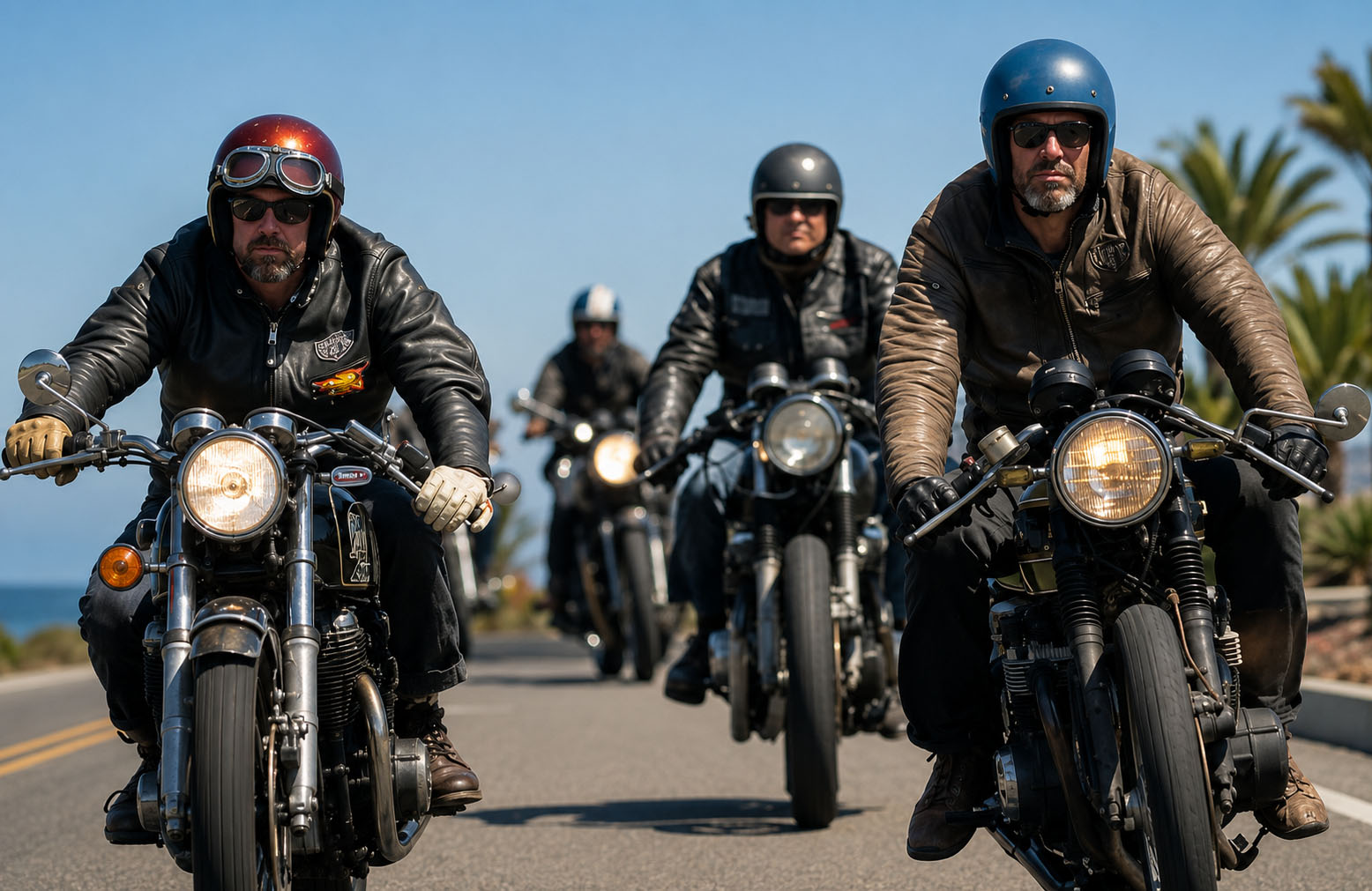
There is no motorcycle subculture quite as visually pure as the café racer. The low bars. The cropped seat. The stripped-back philosophy that says if it doesn't make the bike faster or lighter, it comes off. Born from post-war austerity and amplified by rock 'n' roll, the café racer movement produced some of the most influential machines ever built — and its DNA runs through virtually every custom scene that followed.
The Ace Café and the Birth of a Movement
The story starts on a stretch of North Circular Road in London. The Ace Café opened in 1938 as a roadside transport café — a utilitarian stop for lorry drivers. Post-war, it became something else entirely.
By the early 1950s, the Ace had become the gravitational centre of a new tribe: young, working-class men and women with surplus military motorcycles, a taste for American rock 'n' roll playing on the café jukebox, and a shared obsession with speed.
The ritual was simple. You put a record on the jukebox — typically a 3-minute track — and bet that you could ride to a set point and back before the song ended. To accomplish the round trip in time required hitting 100 miles per hour. Those who achieved it earned the name Ton-Up Boys.
This was not a wealthy sport. These were not expensive machines. The Triumph Bonneville, the BSA Gold Star, the Norton Dominator — these were working bikes, rebuilt and modified in back-street garages with whatever parts could be sourced or fabricated. That constraint became the movement's defining aesthetic: strip everything unnecessary, modify everything that remains.
The Structural DNA of a Classic Café Racer
What made a café racer was not a specific engine or chassis — it was a philosophy expressed through a consistent set of modifications.
Clip-On Handlebars
Standard motorcycle handlebars sit upright, placing the rider in a comfortable, upright position. Clip-on bars clamp directly to the fork tubes below the headstock, forcing the rider into a forward lean. This reduces aerodynamic drag at speed and shifts weight onto the front wheel, improving high-speed stability. It also makes the bike deeply uncomfortable at low speeds — which was considered entirely acceptable.
Rear-Set Footpegs
Factory footpegs are positioned below and ahead of the rider. Rear-sets move them back and up, aligning with the forward lean of the clip-on bars to create a committed, aggressive riding position. Combined with clip-ons, rear-sets place the rider in a near-horizontal crouch that mirrors the position of racing competitors of the era.
Single-Seat Hump (Seat Cowl)
The passenger seat was removed — weight saving, but also symbolic. The café racer was a machine for one. The seat was replaced with a fibreglass or aluminium hump that faired into the tail section, smoothing airflow and completing the visual line from tank to tail.
Bikini Fairing or Bare Front
Many café racers ran a small "bikini" fairing around the headlight — providing minimal wind protection while giving the front end a purposeful, focused appearance. Others ran completely bare fronts, letting the engine and frame speak for themselves.
Weight Reduction Everywhere
Mudguards were bobbed. Lights were removed where legal. Silencers were replaced with straight-through or reverse megaphone exhausts. Every ounce that left the bike was celebrated.
Rock 'n' Roll, Leather, and Identity
The café racer was inseparable from its cultural context. This was the era of Marlon Brando in The Wild One, of Elvis, of a generation rejecting the controlled austerity of post-war Britain. The leather jacket — originally American — became the uniform. The motorcycle became the statement.
Unlike later subcultures built around imported American machinery, the café racer scene was distinctly British. The machines were British. The roads were British. The cafés were British. It was a culture that grew organically from a specific place and moment, which is part of why its imagery has proven so enduring.
The scene peaked in the late 1950s and early 1960s, faded as British motorcycle manufacturers declined through the 1970s, and then — like all the best subcultures — refused to die.
The Modern Revival
The café racer revival began quietly in the early 2000s, driven by small custom workshops — Deus Ex Machina in Sydney, Wrenchmonkees in Copenhagen, Classified Moto in Virginia. These builders took the same approach the original Ton-Up Boys had: take an existing machine, strip it back, rebuild it with intention.
What changed was the platform. The internet allowed these builders to share their work globally, and a worldwide audience hungry for something with soul and history responded immediately.
How Manufacturers Responded
Factory motorcycles began explicitly chasing café racer aesthetics:
- Triumph relaunched the Thruxton — a factory café racer with clip-ons and a seat cowl straight from the original playbook
- BMW released the R nineT, a modular platform explicitly designed to be customised, with factory accessory programmes including café racer bodywork kits
- Honda launched the CB1100 RS with a retro twin-shock rear and clip-on bars
- Royal Enfield's Continental GT brought accessible café racer aesthetics to an entirely new price point and global market
The paradox — a subculture born from anti-establishment rebellion being absorbed into factory catalogues — has not gone unnoticed. But the custom scene has responded by moving further, deeper, and more radically into individualisation, producing machines that no factory could or would sanction.
Why It Endures
The café racer endures because its core values are universal. Strip away everything superfluous. Make what remains as good as it can be. Ride it hard.
In an era of increasingly complex, electronically managed motorcycles with riding modes, traction control, and semi-active suspension, the café racer represents a counter-argument: that the connection between rider, machine, and road should be direct, unmediated, and immediate.
That argument turns out to be timeless.