Naked vs. Sportbikes: The Ultimate Breakdown for Daily Riding and Track Days
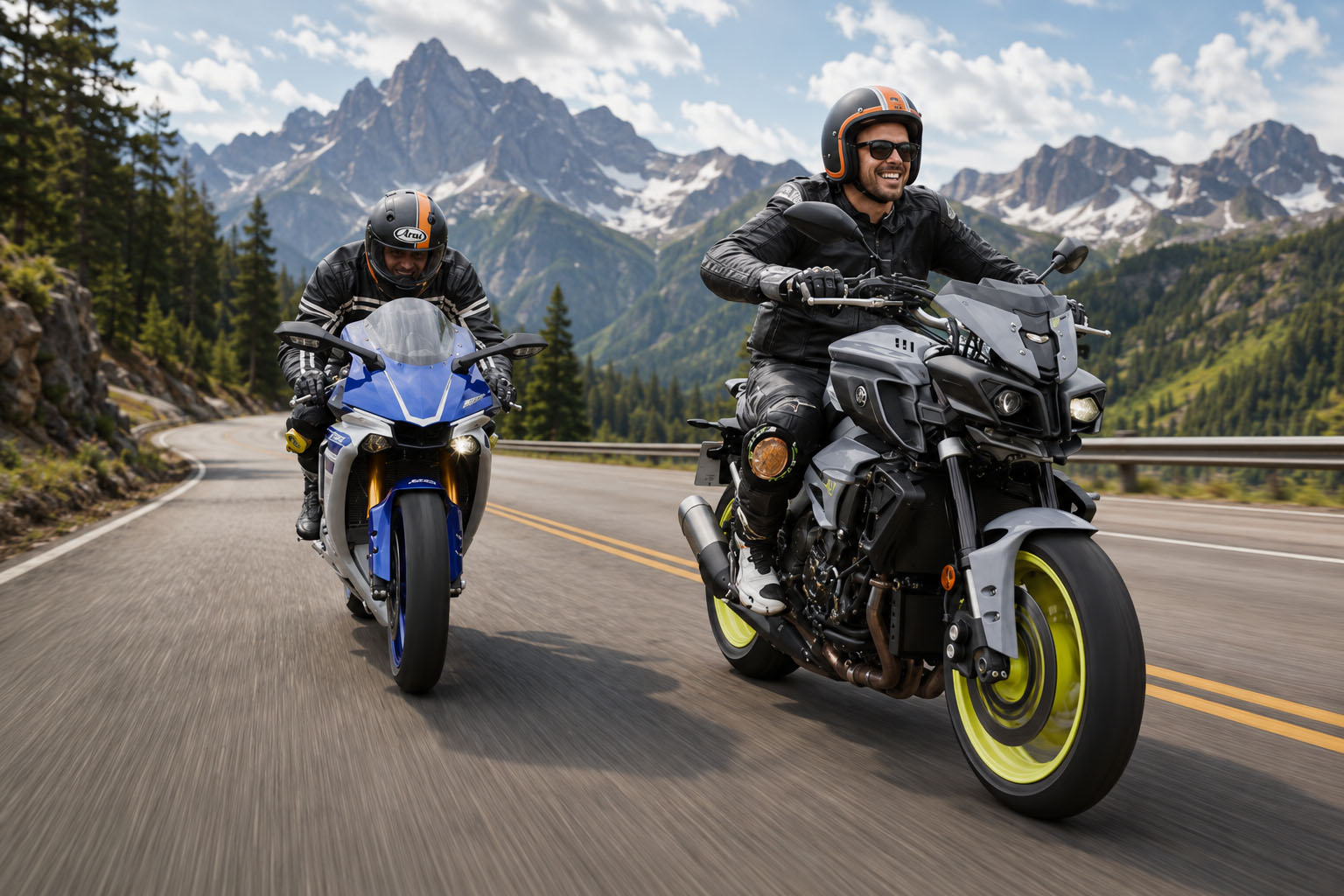
Two philosophies. One engine category. Completely different experiences. The question of whether to buy a naked or a sportbike is one of the most debated in motorcycling — and the answer depends entirely on what you actually do with your riding, not what you imagine you might do.
This breakdown covers every meaningful difference: aerodynamics, ergonomics, power delivery, running costs, and real-world suitability for both daily use and track days.
Structural Differences: Fairing vs. Naked
What the Fairing Actually Does
A full fairing is not decorative. It is a functional aerodynamic system designed around one priority: reducing drag at high speed. At track speeds above 200 km/h, aerodynamic drag becomes the primary resistance force — far greater than rolling resistance. The fairing manages airflow around the engine, directs cooling air to radiators, and channels it away from the rider.
The fairing also provides wind blast protection. On a motorway at 130 km/h, the difference between a faired and naked bike is the difference between effort and comfort. A faired sportbike deflects the wind over and around the rider. A naked bike delivers it directly to the chest and shoulders, dramatically increasing rider fatigue on long rides.
Trade-offs of the faired approach:
- Crash damage is expensive — a low-side that would leave a naked bike with a bent lever now results in shattered fairings costing hundreds to thousands to replace
- More complex maintenance access — routine tasks like checking coolant or spark plugs may require partial fairing removal
- Weight penalty — a full fairing adds 4–7 kg versus a naked equivalent
The Naked's Structural Logic
A naked motorcycle removes the bodywork and exposes the engine, frame, and mechanical components as part of the design language. This is not merely aesthetic. It produces a lighter bike with better crash resilience (bent metal over broken plastic), easier access for maintenance, and a more direct rider-to-machine connection.
Modern hyper-nakeds like the BMW M 1000 R, Ducati Streetfighter V4, and Kawasaki Z H2 are not compromised sportbikes. They are purpose-built machines with aggressive geometry, powerful engines, and premium components — just without bodywork.
Ergonomics: The Rider Triangle
The rider triangle — the relationship between hands, hips, and feet — is fundamentally different between the two categories.
Sportbike Geometry
Sportbikes use clip-on handlebars mounted below the top triple clamp. This forces the rider's upper body into a forward lean. Combined with high rear-set footpegs, the riding position is a committed crouch: weight on wrists and forearms, back nearly parallel to the tank, head raised to see forward.
This position is optimised for:
- High-speed stability (lower centre of gravity, weight over front wheel)
- Aerodynamic efficiency (smaller frontal area)
- Circuit riding (natural body position for trail-braking and late apexing)
This position creates problems for:
- Urban riding (constant minor throttle/brake inputs hurt wrists over time)
- Commuting (traffic concentration requires frequent head turning, strained in a forward-lean position)
- Long motorway stints (back and neck fatigue within 90 minutes for most riders)
Naked Bike Geometry
Naked bikes use wide, conventional handlebars mounted at or above triple-clamp height. Footpegs are mid-position rather than fully rear-set. The riding position is upright to slightly forward-leaning — aggressive but sustainable.
This position excels at:
- Urban agility (full shoulder and arm mobility for quick direction changes)
- Mixed-use riding (comfortable across commuting, canyons, and occasional highway)
- Rider confidence (upright position gives better visibility and more natural weight distribution)
Limitation: At sustained track speeds above 180 km/h, wind blast in an upright position becomes genuinely fatiguing — you are pushing against air rather than letting the fairing manage it.
Power Delivery: Street vs. Track Tuning
Sportbike Power Characteristics
Supersport bikes (600cc class: Yamaha R6, Honda CBR600RR, Kawasaki ZX-6R) produce peak power in a narrow high-RPM window — typically 10,000–14,000 RPM. Below 7,000 RPM, they are often sluggish. This characteristic is tuned for circuit racing, where the bike is always in the upper rev range.
Street reality: In daily traffic, spending time below the power band means constant short-shifting and frustration. The same engine that feels electric on a race circuit feels awkward in a roundabout.
Litre-class sportbikes (1000cc: BMW S 1000 RR, Ducati Panigale V4) have broader power delivery but are still optimised for high-rev performance, with multiple riding modes required to make street use manageable.
Naked Bike Power Characteristics
Hyper-nakeds are tuned for mid-range torque. The MT-09's 890cc triple, the Z H2's supercharged 998cc four, and the Streetfighter V4's 1103cc V4 all produce strong torque from 4,000–6,000 RPM — the range where street riding actually happens.
This makes naked bikes feel faster in real-world use despite sometimes having lower peak power figures than equivalent sportbikes. Street acceleration is torque, not peak horsepower.
Long-Term Ownership Costs
| Cost Factor | Sportbike | Naked Bike |
|---|---|---|
| Minor crash damage | High (fairing replacement: $200–$2,000+) | Low (levers, pegs, bar ends: $50–$200) |
| Tyre wear | High (rear tyre: 5,000–8,000 km) | Moderate (7,000–10,000 km typical) |
| Maintenance access | Moderate (partial fairing removal often needed) | Easy (all components accessible) |
| Insurance | Higher (sportbike category) | Moderate |
| Resale value | High for blue-chip models (R6, CBR1000RR) | Strong for hyper-nakeds |
Which to Choose
Choose a sportbike if: You ride circuits regularly, prioritise absolute top-speed capability, and the ergonomic compromise suits your body and riding duration.
Choose a naked if: You ride daily, do mixed street/track work, want lower maintenance costs, or value the flexibility of a machine that genuinely works in all contexts.
The hyper-naked category has matured to the point where "naked" no longer implies any performance compromise versus faired alternatives — only a difference in where and how that performance is delivered.