Understanding Engine Configurations: Singles, Twins, Triples, and Inline-Fours
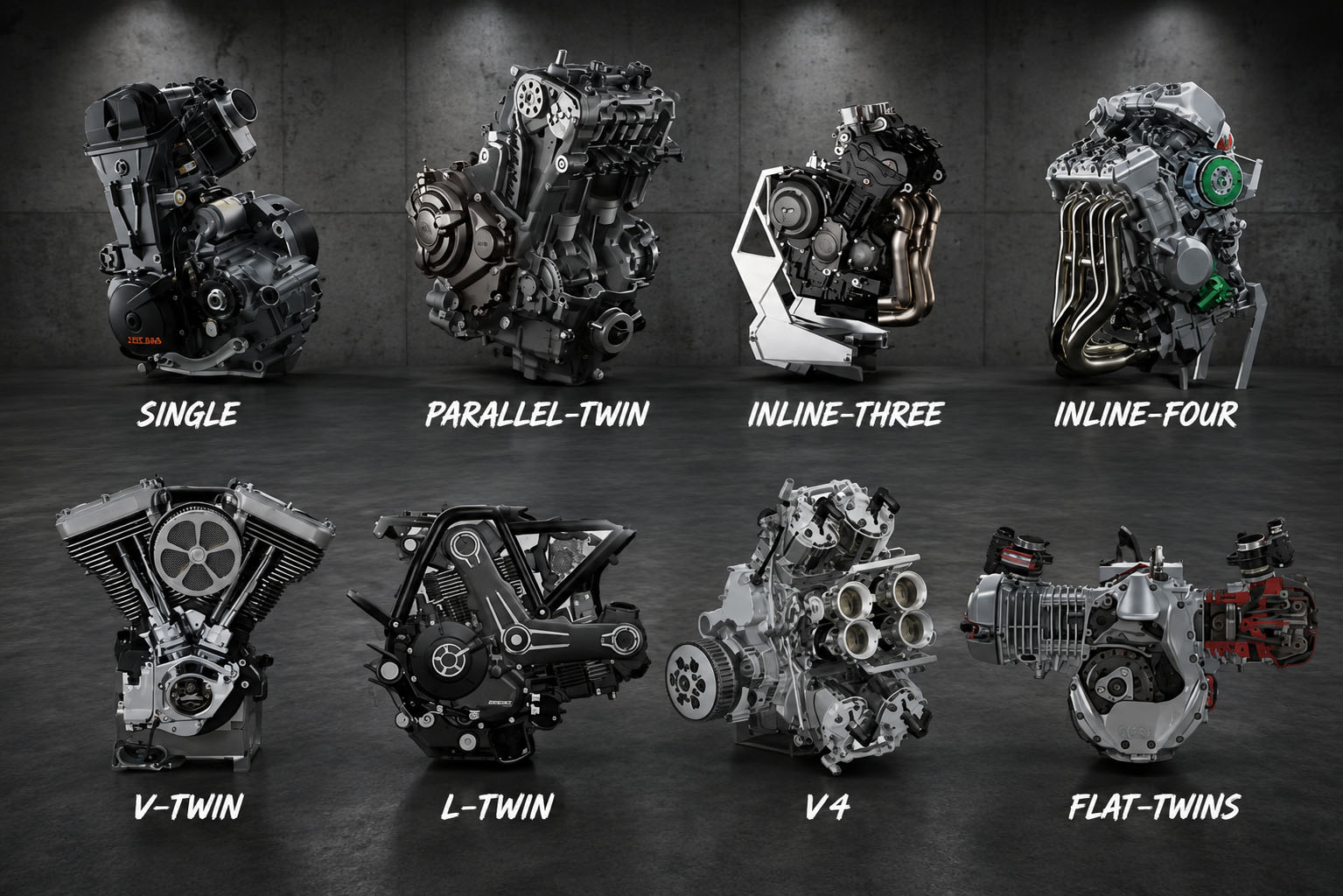
Every motorcycle engine is an architecture with a personality. The same displacement can feel lumbering or electric, lazy or surgical, mechanical or symphonic — depending entirely on how the cylinders are arranged and how they fire. This guide breaks down the four fundamental configurations and explains why each produces a fundamentally different riding experience.
Single-Cylinder: The Thumper
How It Works
A single-cylinder engine fires once per crankshaft revolution (four-stroke). This produces a distinct, pronounced power pulse with a long pause between each firing event — the characteristic thump that gives these engines their nickname.
Power Characteristics
Singles are inherently unbalanced. The single large piston moving up and down creates primary vibration that no amount of counterbalancing can fully eliminate. Manufacturers use counterbalancers to reduce the worst frequencies, but a single will always communicate more mechanical character through the bars and pegs than a multi-cylinder equivalent.
Torque delivery: Singles produce strong low-RPM torque relative to their displacement. A 450cc single makes usable power from 3,000 RPM. Peak torque arrives early and sustains through the mid-range before dropping off. This characteristic makes singles forgiving in technical terrain — gradual, predictable power delivery that doesn't punish throttle imprecision.
Top-end limitation: The single large piston has significant reciprocating mass. Spinning it fast requires increasingly powerful con rod and crankshaft forces. As a result, singles generally redline at 7,500–9,500 RPM rather than the 12,000–14,000 RPM possible with lighter multi-cylinder pistons. This caps peak power output — a 450cc single typically produces 40–55 bhp.
Ideal Applications
Singles are the preferred choice for:
- Off-road and enduro riding (KTM 450 EXC-F, Honda CRF450L)
- Entry-level and A2 licence-compliant motorcycles
- Low-maintenance commuting
- Lightweight touring on developing-world roads where simplicity matters
Twins: V-Twins and Parallel Twins
V-Twin Architecture
A V-twin mounts two cylinders in a V configuration — typically 45°, 60°, or 90° depending on the manufacturer. Ducati uses a 90° L-twin (technically a V-twin rotated 90°). Harley-Davidson uses 45°. Each angle produces different vibration characteristics and packaging requirements.
At 90°, the V-twin achieves perfect primary balance — the pistons' inertia forces cancel each other out across the firing cycle. This is why 90° V-twins (Ducati, Moto Guzzi transversely mounted) feel notably smooth for two-cylinder engines.
Power delivery: V-twins produce high torque from low RPM with a distinctive "potato-potato" firing rhythm at low speed. The Ducati Panigale V2's 955cc V-twin makes peak torque at 6,500 RPM — accessible torque by large-displacement sportbike standards. The power delivery is muscular and linear rather than building exponentially toward a high-RPM peak.
Parallel Twin: The 270° Firing Order Revolution
Traditional parallel twins (two cylinders side by side) fired at 360° intervals — both pistons reaching top dead centre simultaneously. This produced a flat, buzzy character that felt uninspiring.
The modern 270° firing order (adopted by Yamaha CP2 engine in the MT-07 and R7, Honda's Africa Twin, and KTM twins) creates an irregular firing interval where the engine fires, pauses briefly, fires again, then takes a longer pause. This replicates the character of a V-twin — a hint of pulse and rhythm — while maintaining the compact packaging and lower production cost of a parallel layout.
The Yamaha MT-07's 689cc CP2 engine is the exemplar of this philosophy: a twin that produces broad torque, sounds characterful, and delivers power in a way that feels alive rather than mechanical.
The Triple: The Sweet Spot
Why Three Cylinders Work
A three-cylinder engine occupies a genuinely distinct character space between the torquey twin and the surgical inline-four. It has more reciprocating piston events per revolution than a twin but fewer than a four — which means more power strokes per crankshaft revolution than a twin, but without the narrow, high-RPM power band of the four.
The result: mid-range grunt that equals or exceeds the twin, plus a top-end rush that approaches the four. The triple is not a compromise between the two — it is a third architecture with its own character.
Firing Order and Sound
A three-cylinder firing order produces a distinctive exhaust note — a layered, complex sound with a mechanical quality that many riders describe as the most characterful of any configuration. Triumph's 765cc triple (Street Triple, Tiger Sport 765) is frequently cited as one of the best-sounding engines in production motorcycles.
Torque spread: The Triumph 765cc Street Triple R makes 80 Nm peak torque arriving at 9,400 RPM, but 72+ Nm is available from 5,500 RPM onward. This broad availability makes the triple extremely user-friendly in real-world riding.
Where Triples Excel
- Sports-naked bikes (Triumph Street Triple, MV Agusta Brutale 800)
- Mid-range sports tourers (Triumph Tiger 900, Yamaha Tracer 9)
- Any application where the riding requires both low-speed flexibility and high-speed excitement
Inline-Four: The High-RPM Screamer
Architecture and Characteristics
Four cylinders in a row, each firing every 180° of crankshaft rotation in a 1-3-4-2 or 1-2-4-3 sequence. The inline-four's defining characteristic is mechanical precision — all four pistons are small and light relative to a twin's single large piston, allowing the engine to rev freely to extremely high RPM.
Power Characteristics
Below 6,000 RPM, a high-strung inline-four feels underwhelming — acceleration is modest and the engine seems to be waiting. Cross 8,000 RPM and the character transforms. The Yamaha R6's 599cc inline-four produces peak power at 14,500 RPM — an RPM range that produces a mechanical howl impossible to replicate with any other configuration.
This top-end power delivery is the inline-four's defining feature and its primary limitation. On a race circuit where you can keep the engine in its upper range, it is exhilarating. In city traffic where you're spinning below 5,000 RPM, the same engine feels flat and unresponsive.
Evolution Toward More Usable Delivery
The original 600cc supersport inline-fours (R6, CBR600RR, ZX-6R) were optimised purely for peak power. Modern litre-class inline-fours (R1, CBR1000RR-R, ZX-10R) have moved toward broader torque delivery through variable valve timing, revised cam profiles, and longer-stroke geometries — retaining the high-RPM peak while making the lower range more usable.
Comparison Summary
| Configuration | Peak Torque RPM | Character | Ideal Use |
|---|---|---|---|
| Single | 4,000–6,000 | Thumpy, physical, forgiving | Off-road, commuting, lightweight touring |
| V-Twin | 5,000–7,000 | Muscular, rhythmic, character-rich | Cruisers, Ducati-style sportbikes, naked torque machines |
| Parallel Twin (270°) | 6,000–8,000 | Balanced, versatile, characterful | All-rounder: commuting to canyon riding |
| Triple | 8,000–10,000 | Broad and exciting, unique sound | Sports nakeds, sports tourers, do-everything bikes |
| Inline-Four | 10,000–14,000 | Precise, clinical, electric at high RPM | Circuit racing, ultimate top-end performance |
The right configuration is the one that matches the RPM range where you actually ride. Riders who spend most of their time in urban traffic at 3,000–5,000 RPM will enjoy a single or twin far more than an inline-four — regardless of peak power figures. Riders who chase circuits will find the inverse.
Sound and sensation matter too. Motorcycling is not purely functional. An engine that you want to hear — that rewards revving, that has a voice — makes you a more engaged and consequently better rider.